Helping Keep Horses Safe Before, During, and After Emergencies
At Franklin County Saddle Club (FCSC), we believe disaster preparedness begins long before an evacuation order is issued.
Whether it’s wildfire, flooding, severe weather, or another emergency, having a plan can make all the difference for you, your family, and your horses.
That’s why FCSC has partnered with the Richland Riders Club (RRC) to help build the Tri-Cities Equine Disaster Network—a collaborative effort dedicated to improving communication, sharing resources, supporting horse owners, and strengthening equine emergency preparedness throughout our region. The partnership focuses on developing educational resources, refining evacuation processes, and working alongside local first responders to better serve the equestrian community.
Emergency Horse Shelter
When disasters require the evacuation of horses, Franklin County Saddle Club may provide temporary emergency horse shelter on a space-available basis.
Our goal is to provide horse owners with a safe location while they work through the challenges created by an emergency.
Emergency shelter includes:
- Covered horse stalls
- Trailer parking
- Water access
- Check-in assistance
- Facility orientation
- Safe and organized accommodations
Emergency shelter is available as capacity allows, and stall assignments are based on available space, safety considerations, and operational needs. Extended stays may require daily stall fees depending on the circumstances of the emergency.
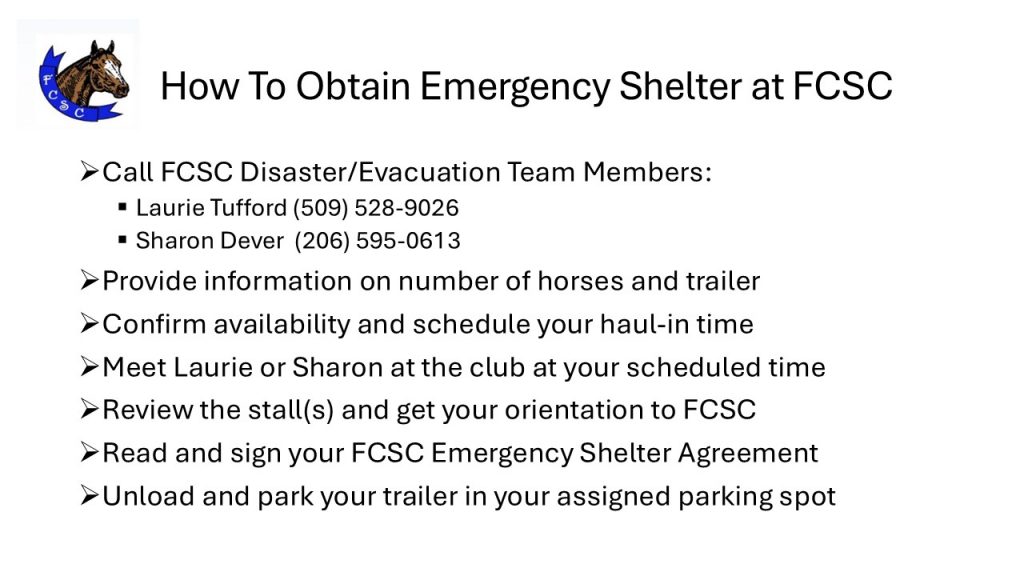
How to Obtain Emergency Shelter
If you need emergency shelter for your horses:
Step 1
Call one of our Emergency Shelter Coordinators:
Laurie Tufford
📞 (509) 528-9026
Sharon Dever
📞 (206) 595-0613
Step 2
Provide:
- Number of horses
- Trailer information
- Estimated arrival time
Step 3
Wait for confirmation that stalls are available and your arrival time has been scheduled.
Step 4
Upon arrival, an FCSC representative will:
- Meet you at the facility
- Show you your assigned stalls
- Review facility procedures
- Complete the Emergency Shelter Agreement
- Direct you to your designated parking area
Only after check-in should horses be unloaded.
During Your Stay
Owners remain responsible for:
- Feeding and watering horses
- Daily stall cleaning
- Proper feed and hay storage
- Following all FCSC Rules and By-Laws
- Keeping the facility clean and safe
FCSC volunteers may assist with facility operations; however, horse care remains the responsibility of each owner unless otherwise agreed upon.
Build Your Horse Emergency Plan Today
Every horse owner should prepare before disaster strikes.
Preparing now can significantly reduce stress during an evacuation.
Equine Emergency Planning Resources
HALTER Project (Equine Disaster Compendium)
Comprehensive equine emergency preparedness resources, rescue organizations, evacuation planning, and disaster education.
Emergency Notifications & Alerts
Benton County CodeRED
Official emergency notifications for Benton County including wildfires, evacuations, severe weather, and other public safety alerts.
Franklin County Emergency Management
Emergency preparedness information, local alerts, and disaster response resources for Franklin County.
Benton County Emergency Management
Emergency planning, preparedness resources, and emergency information for Benton County.
Wildfire Resources
Watch Duty
Real-time wildfire tracking, evacuation zones, fire perimeters, air quality, and official incident updates.
Washington Department of Natural Resources (DNR) Wildfire Dashboard
Current wildfire information, fire maps, burn restrictions, and incident updates across Washington State.
InciWeb
National Incident Information System providing updates on major wildfires throughout the United States.
Emergency Response
PulsePoint
Track real-time emergency responses from participating fire departments and EMS agencies.
Flood Monitoring
NOAA Yakima River at Kiona
Monitor river levels, stream flow, and flood conditions affecting the Tri-Cities area.
Weather
National Weather Service – Pendleton
Official weather forecasts, watches, warnings, and hazardous weather information for the Tri-Cities region.
Road Conditions & Travel
Washington State Department of Transportation (WSDOT)
Current road conditions, closures, mountain pass reports, travel alerts, and live traffic cameras.
Emergency Preparedness
Ready.gov – Pets & Animals
Federal guidance for preparing pets and livestock before disasters.
Washington Emergency Management Division
Preparedness resources, emergency planning, alerts, and statewide disaster information.
Air Medical Transport
Life Flight Network
Membership information for emergency air medical transportation throughout Washington and the Pacific Northwest.
Disclaimer: The links above are provided as informational resources to assist horse owners with emergency preparedness. Franklin County Saddle Club does not operate or control these third-party websites and encourages users to verify information through official emergency management agencies during an active incident.
Our Commitment
Franklin County Saddle Club is proud to work alongside local equestrian organizations to strengthen disaster preparedness throughout the Tri-Cities.
Together, we’re building a network that emphasizes preparedness, communication, education, and community support—so that when emergencies occur, horse owners have reliable information and a place to turn.